You want to help people, not harm them. But if you're designing websites, apps, or digital products without thinking about trauma, you might be doing exactly that.
I co-wrote an academic article with Dr. Lesley-Ann Noel for the journal Diseña about how digital design causes real harm to real people and what designers can do about it. The paper is called "Repairing the Harm of Digital Design Using a Trauma-informed Approach." Here's the short version, minus the academic writing I had to do. (You're welcome. Academic writing is rough, not kidding.)
The Problem Is Bigger Than You Think
The tech industry designs for about 80 percent of people. The dominant group. Everyone else gets treated as an "edge case." But here's the thing -- disabled people, nonbinary people, people of color, people in the Global South, trauma survivors -- that's not an edge case. That's a whole lot of humans getting left out.
And the harm shows up in ways y'all might not expect:
Facial recognition that works on light-skinned faces but not dark-skinned ones
Online forms that only offer "male" or "female" as gender options
Less than 3 percent of websites meeting basic accessibility standards
Safety apps for women in the Global South that don't account for the real barriers women face in using them
The kicker? Some of the worst offenders are websites built specifically to help marginalized people. (UGH!) A domestic violence agency website with no search function and post-graduate reading level text. A low-income energy assistance site that doesn't even work on a phone. These aren't hypothetical. These are real examples from our research.
“Where There's Humans, There's Trauma”
I’ve heard a version of this phrase from many psychologists and social workers. Most people hear the word "trauma" and picture extreme situations. Tornadoes and terrible childhoods. But trauma is way more common than that. It includes things like racism, loss, displacement, and systemic exclusion. Marginalized communities experience it at higher rates. And when someone who has experienced trauma hits a confusing, exclusionary website, that design choice can actually make things worse.
Social exclusion itself is now being recognized as a form of trauma. So when your digital product tells someone "this wasn't made for you," that's not just bad UX. It can cause real psychological harm.
So What Do We Do About It?
Our article lays out two practical approaches for designers who want to stop causing harm and start repairing it.
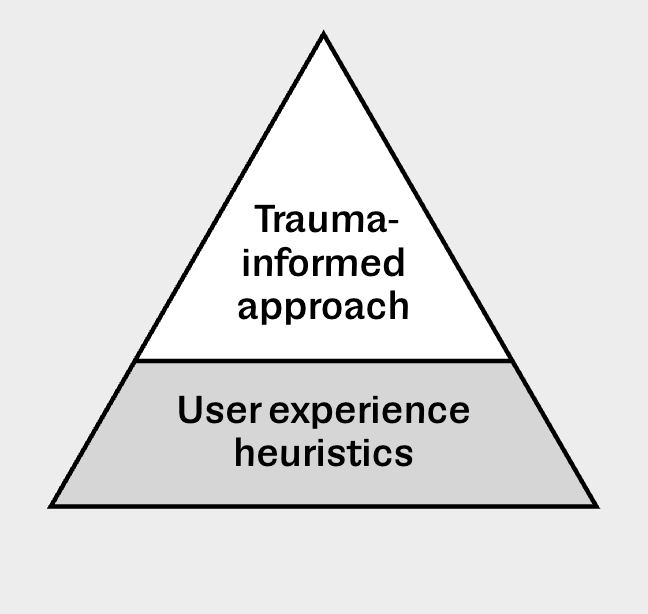
Start with UX heuristics. This is the foundation. Nielsen's usability principles from 1994 still hold up, and they matter even more for trauma survivors. Things like keeping people informed about what's happening on screen, using plain language, giving people control and the ability to undo errors, and reducing cognitive load. These aren't fancy concepts. They're basics that too many websites still get wrong.
Then layer on a trauma-informed framework. SAMHSA (the Substance Abuse and Mental Health Services Administration) has six principles that were developed for clinical settings but can apply directly to design:
Safety
Trustworthiness and Transparency
Peer Support
Collaboration and Mutuality
Empowerment, Voice, and Choice
Cultural, Historical, and Gender Issues
We see this as a pyramid. UX heuristics are the base. Trauma-informed principles go on top. You need both.
What This Looks Like in Practice
Say you're designing an online form. First, make sure it follows basic UX best practices on both desktop and mobile. Then ask yourself the harder questions:
Does this form explain where the data goes and how it's used?
Can the user reach a real person if they need help?
Am I forcing people to disclose information they might not feel safe sharing?
Does the form respect the many identities of the people using it?
These questions aren't just for social services websites. Financial apps, healthcare portals, government sites -- any digital product where trust matters (which is all of them) benefits from this thinking.
This Isn't Just for "Extreme" Cases
People assume trauma-informed design is only for crisis centers or mental health apps. That is nonsense. Trauma-informed design is just better design. It's an upgrade to your existing practice.
You don't need a degree in psychology or social work to do this. You need awareness, a willingness to learn about trauma, and the discipline to apply what you already know about good design more thoughtfully.
It's a Process, Not a Destination

Becoming trauma-informed takes time. It's not a box you check. Our understanding of trauma and its impact on technology keeps evolving, so the work keeps evolving too. Every digital product is basically a prototype that can get better.
The point is to start. Learn about trauma. Evaluate your designs against both UX heuristics and trauma-informed principles. Talk to the people your product is supposed to serve, especially the ones who've been harmed by exclusion.
Digital designers have a powerful role in society. We decide who gets included and who gets left out. That's not a responsibility to take lightly.
Ready to dig in? The full article is published in Diseña, Issue 24. And if you want to learn more about trauma-informed principles, check out this LinkedIn Learning Course.