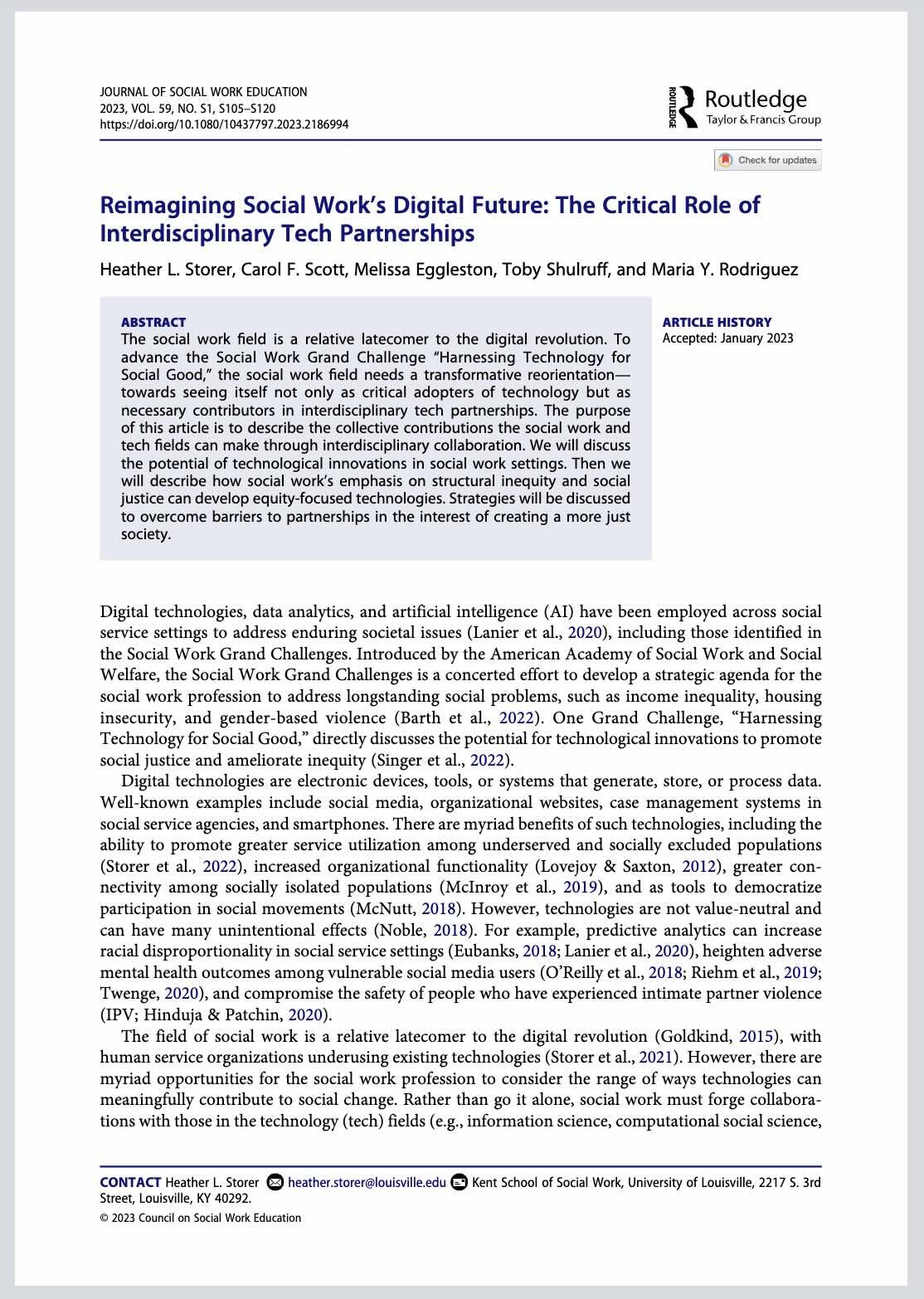
When you make friends with professionals outside of technology, you never know what it will lead to. In my case, I met some clinicians and researchers through the Trauma-Informed Design Discussion Group and next thing you know, I’m writing an academic paper with them.
It was published in the Journal of Social Work Education, and it's called "Reimagining Social Work's Digital Future: The Critical Role of Interdisciplinary Tech Partnerships." The lead author is Dr. Heather Storer out of the University of Louisville, along with Carol Scott, Toby Shulruff, and Maria Rodriguez. I came in as a contributor from the tech side, bringing the UX and design perspective to the table.
Here's why this matters. Social work as a field has been slow to adopt digital technology. And tech, for its part, has been slow to consider the people who need it most. This paper argues that when those two worlds actually collaborate, the results are better for everyone, especially for the communities being served.
Why I Got Involved
Our author team was intentionally cross-disciplinary. Social workers, computational social scientists, public interest technologists, and me, as a UX researcher and designer. The whole point was to practice what the paper preaches. If you're going to write about interdisciplinary collaboration, your team needs to reflect it too.
My role was grounded in what I do every day – human-centered design, usability testing, mobile-first thinking, service design, etc. Tech world has refined these approaches over decades, and they have real potential to improve how social services reach people.
What the Paper Covers
The paper makes the case that social work and tech fields each bring something the other needs.
From the tech side, we contribute things like:
Human-centered design processes that keep real users at the center of product decisions
Usability testing that catches problems before they reach vulnerable populations
Mobile-first approaches that meet people where they actually are, often on their phones
Service design that maps the full experience of someone navigating a system, not just one touchpoint
From the social work side, the contributions are just as critical:
A commitment to centering people who have been systemically marginalized, not just the majority
An understanding that tech is never neutral as it carries the biases of the people who build it
Awareness of trauma and how digital tools can unintentionally cause harm
Deep knowledge of how systems of oppression shape people's real-world experiences
Neither side has the full picture alone. That's the whole point.
Highlights
One highlight of the paper may resonate with folks working in traditional technology such as ecommerce, fintech, etc. Tech teams often use the 80/20 rule -- design for 80% of users and call it good. But that remaining 20%? Those are often the people who need the tool the most. People with disabilities. People with low digital literacy. People in crisis.
The social work field flips that. Start with the people on the margins. Design for them first. If the tool works for someone in a difficult situation with limited resources, it's going to work for everyone else too. (Hmm, this sounds similar to accessibility improvements, doesn’t it?)
This isn’t a radical idea in UX circles. It's just good design. But it's one that gets skipped more than you might think.
Trauma-informed design is still gaining traction in our field, and social work has decades of practice at making things more trauma-informed. Tech designers doing user research or building forms can cause real harm if they aren't thinking about trauma. Clinicians such as psychologists and social workers can help tech teams understand that, without everyone needing a clinical background.
Why This Matters Beyond Academia
Academic papers don't always translate into action. This one does! We offer a suggestions on how tech and social work professionals can start working together. Not in a theoretical way but in a "here's what each side brings” way, so you can seek each other out.
If you work in civic tech, nonprofits, public interest technology, or any space where your users are navigating hard situations, this paper is worth your time. You can read the full article in the Journal of Social Work Education.
And if you're a tech person who has ever thought "there has to be a better way to build tools for people in tough spots” well, you're absolurely right. Start by talking to social workers and other clinicians who already know those populations well.