Great Infographics Book

I'm an avid reader of both fiction and non-fiction. I'll take a book over television, movies, or games any day. Right now one of the books I'm really enjoying is The Functional Art: An introduction to information graphics and visualization. It's written by Alberto Cairo, one of the folks who attracted me to graduate school at the University of North Carolina School of Journalism and Mass Communication. (Now he's moved on to the University of Miami). I didn't have the chance to learn directly from Cairo as he was on leave when I was at grad school, so I wanted to check out his book.
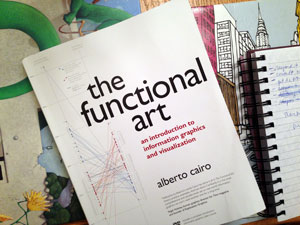
The Functional Art Book cover

What I'm really liking (and I'm only on p.80) are the practical examples he offers from his own career. He also offers context and history about the field of infographics - for example, explaining the stark differences between Nigel Holmes and Edward Tufte. These two men have influenced infographics and data visualization greatly, and I was fortunate to hear both of them speak live in 2008 (not together, I can't imagine that would happen). There is value in both of their perspectives.

This book really seems to provide a nice lay of the landscape to someone new to infographics as well as some really practical direction. It has reminded me of things I forgot from my coursework already. I haven't dug into the instructional DVD yet.

My favorite quote of the book so far:

" . . .graphics should not simplify messages. They should clarify them, highlight trends, uncover patterns, and reveal realities not visible before." 

I'm looking forward to reading more.

Three Reasons to Go to WordCamp

Wordpress Logo I had a fantastic weekend attending WordCamp Raleigh, a conference for those using or working with WordPress (WP). Just in case you don't know, WP is an open source content-management system and blogging tool based on PHP and MySQL. I use it to run my website and those of my clients.

I learned a bunch of helpful things at WordCamp - plug-ins and e-commerce tools and even some of the history of WP. There were three tracks of sessions you could attend - users, power users, and developers - lots of options no matter what your level of understanding of WP is. Some folks had been using it for years (WP has been around 10 years,) but others had just started exploring it two weeks prior.

Here are three reasons to go to a WordCamp:

1) Ubiquitous use. Approximately 20% of the websites in the world are run on the WordPress system from tiny blogs to major sites like CNN. Even if you think you don't want to use the WordPress system, it's good to understand it so you can compare other systems to it. How else will you know if WordPress is right to use for your business or blog (or those of your clients)?

2) Unbelievably friendly users. Maybe it's the open source thing, but wow, I was impressed by how forthcoming and helpful WordCamp speakers and fellow attendees were. The conference organizers were on site and very nice as well. The event was organized but informal, which I liked.

3) Unbeatable value. Professional development was a stellar deal for a mere $35 conference fee, which also included lunch and a t-shirt. And I was able to sit down with and ask questions directly of core contributors to WordPress. All of my questions were answered, and during the various sessions, I was exposed to features of WordPress that I was unfamiliar with. Super helpful.

So, go check out the upcoming schedule of worldwide WordCamps and see if you can attend!

Om into Productivity

My productivity and focus increased by about 40% after I meditated for 20 minutes today. In a short period, I wrote a bio for one website, finalized the schedule for a new website project, thanked a referral source, and did some research. And I had fun doing it. That is all. Om!

Three Rules to Avoid the Blog Graveyard

I've seen so many inactive blogs are out there! I'm brainstorming how to avoid ending up in the blog graveyard. Many people, including me, have started blogs and then stopped for various reasons. I understand that some blogs naturally have a short life, but many end because of blogging burnout or other priorities taking over.

To avoid this, I’m coming up with a few rules for my new blog on communication topics:

1) One line is good enough. Sometimes I may not have much to say or time to say it. And that’s ok. One line, one photo, one complete thought is enough for a post.

2) No scheduled content. I refuse to write a blog post because I “should.”  Obligatory blog posts completely ruin the fun of blogging for me. If I don’t have anything to share that is either useful to others OR helpful for me to express, then I wait. This means I may post three times one week, and then maybe not post for another three weeks.

3) Respond to comments. I commit to responding to comments on my blog or social media posts I make. If I don’t, I miss the chance to connect with others, which is one of my main motives for blogging.

With these guidelines in mind, I'm feeling enthusiastic about blogging again!